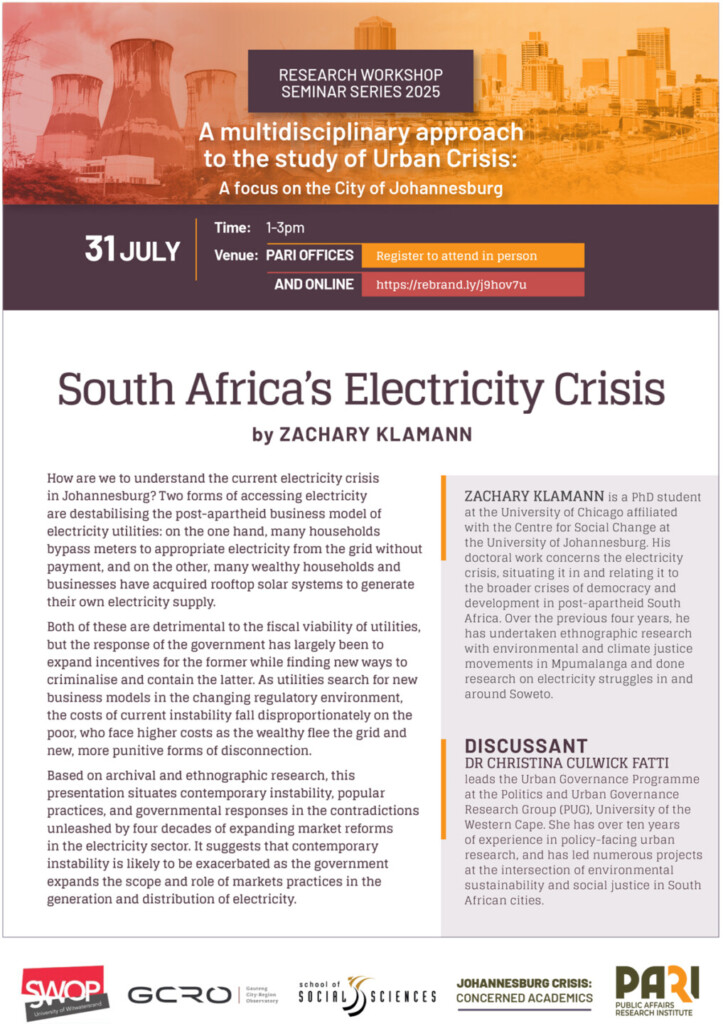
South Africa’s Electricity Crisis
Presenter: Zachary Klamann (University of Chicago)
Discussant: Dr Christina Culwick Fatti (University of the Western Cape)
Date: 31 July 2025
Time: 1-3pm
Venue: PARI offices and online
Register to attend in-person here and online here
Abstract
Abstract: How are we to understand the current electricity crises in Johannesburg? Two forms of accessing electricity are destabilising the post-apartheid business model of electricity utilities: on the one hand, many households bypass meters to appropriate electricity from the grid without payment, and on the other, many wealthy households and businesses have acquired rooftop solar systems to generate their own electricity supply.
Both of these are detrimental to the fiscal viability of utilities, but the response of the government has largely been to expand incentives for the former while finding new ways to criminalise and contain the latter. As utilities search for new business models in the changing regulatory environment, the costs of current instability fall disproportionately on the poor, who face higher costs as the wealthy flee the grid and new, more punitive forms of disconnection.
Based on archival and ethnographic research, this presentation situates contemporary instability, popular practices, and governmental responses in the contradictions unleashed by four decades of expanding market reforms in the electricity sector. It suggests that contemporary instability is likely to be exacerbated as the government expands the scope and role of markets practices in the generation and distribution of electricity.
About the series
The Public Affairs Research Institute (PARI), Society, Work and Politics Institute (SWOP), Gauteng City-Region Observatory (GCRO) and the Johannesburg Crisis: Concerned Academics, continue this seminar series to offer scholars, researchers, and postgraduate students an opportunity to share their ongoing work, either by discussing work in progress or presenting upcoming and new publications on the City of Johannesburg.
In 2025, the series provides a collaborative space and dialogue to scholars, researchers, activists and policy makers, to share their ongoing work on the City of Johannesburg.
This is an itinerant series and the details of each seminar will be published one week prior.